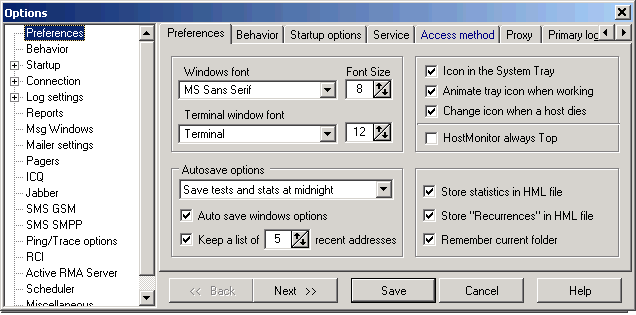
Options Dialog
You can define "global" HostMonitor's settings in the Options dialog window.
Customize the color palette for HTML logs & reports, mailer parameters, proxy settings,
log file formats, options for utilities, etc. Options are categorized on different pages
and navigation is made through a convenient tree structure.
The film uses watercolor backgrounds, a technique abandoned by Disney after The Jungle Book (1967) due to the rise of Xerography. The result is a world that feels hot, humid, and fragile. The colors bleed slightly at the edges. The character designs are loose, angular, and cartoony—Stitch’s gangly limbs and six tentacles are drawn for expression, not realism.
Twenty years later, Lilo & Stitch is no longer just a cult classic; it is widely regarded as one of Disney’s most profound, emotionally intelligent, and artistically daring films. It is a story not about finding a prince or saving a kingdom, but about the radical, messy, and often painful act of keeping a family together. To understand Lilo & Stitch , one must first look at its skin. After the lavish, photorealistic ballrooms of Beauty and the Beast and the sweeping African savannahs of The Lion King , director Chris Sanders and co-director Dean DeBlois made a radical choice: they went small and rough. Lilo y Stitch
Lilo & Stitch is the ugly duckling of the Disney canon. It is too sad for small children, too weird for the boardroom, and too real for a fairy tale. But for those who find it, it offers the most profound truth Disney has ever told: You don't have to be perfect to be family. You just have to stay. The film uses watercolor backgrounds, a technique abandoned
The joke is that the all-powerful Galactic Federation has no idea how to handle Earth. They view it as a "primitive" planet, but they are terrified of its social workers, its tourist traps, and its weirdly resilient children. The aliens' sophisticated technology (lasers, teleportation, cloaking devices) is consistently foiled by mundane human chaos—a falling dryer, a puddle of glue, or a social worker’s intuition. To understand Lilo & Stitch , one must
This aesthetic isn't a regression; it is a thematic choice. The messy, soft, imperfect look of the film mirrors the chaotic, imperfect life of its protagonist, Lilo. There are no crystal chandeliers here, only a rusted lawn chair on a porch overlooking a stormy sea. At the heart of the film are two characters who, by Disney standards, should have been unlikable.
In the summer of 2002, the Disney animated canon was in a peculiar state. The studio was emerging from the so-called "Disney Renaissance" (1989-1999) but had stumbled with early 2000s efforts like The Emperor's New Groove and Atlantis: The Lost Empire . Audiences expected another fairy-tale musical or a mythological epic. Instead, they got watercolors of a crumbling Hawaiian bungalow, a soundtrack of Elvis Presley, and a blue, genetically-engineered creature who quotes The Ugly Duckling .
The film refuses to sanitize its protagonists' pain. Lilo is not "sassy"; she is angry. Stitch is not "mischievous"; he is dangerous. Their journey together is about two broken things finding a way to fit, not by fixing each other, but by accepting the cracks. The film’s most famous line is often quoted, but rarely understood in its full context: "'Ohana' means 'family.' 'Family' means nobody gets left behind—or forgotten." In most Disney films, this would be a triumphant, inspiring motto. In Lilo & Stitch , it is a weapon, a burden, and a painful reminder.