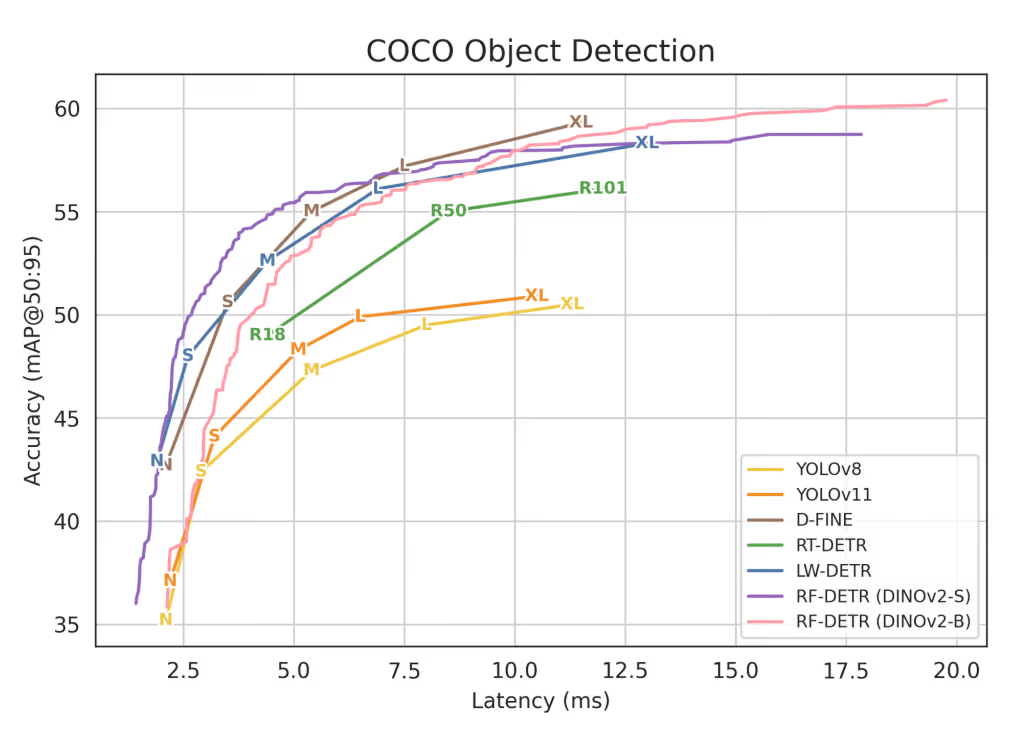
YOLOv8 is a computer vision model architecture developed by Ultralytics, the creators of YOLOv5. You can deploy YOLOv8 models on a wide range of devices, including NVIDIA Jetson, NVIDIA GPUs, and macOS systems with Roboflow Inference, an open source Python package for running vision models.
For a kid with limited gaming time, or a completionist who just wanted to see the ending cutscene (a helicopter flyover of the finish line in Ensenada), finishing legitimately was a fantasy. Thus, the demand for "save game" files was born. Unlike modern games with encrypted, cloud-synced blobs, Baja 1000 saved data in a simple, almost innocent file, typically named BAJA.SAV or SAVEGAME.DAT . It lived right in the game’s installation directory—C:\BAJA1000. No registry keys. No hidden AppData folders.
So, if you find that old CD, or the ISO, and you hit the wall in the Canyon de la Muerte for the 50th time, go ahead. Search for "Baja 1000 PC save game all vehicles." Find BAJA1000_SAVE_COMPLETE.zip . Unzip it. Copy it over. Download Save Game Baja 1000 Pc
The year is 1996. You’re sitting in front a bulky CRT monitor, the whir of the CD-ROM drive sounding like a distant dune buggy engine. You pop in Baja 1000 , developed by the now-defunct Distinctive Software Inc. (later EA Canada). It’s brutally hard. Not "dark souls" hard, but "90s PC sim-hard." One rock, one wrong shift, one moment of distraction crossing the Vizcaíno Desert, and your suspension is shattered. You’ve never finished the full 1,000-mile course. The in-game save system is a cruel joke—one save slot, overwritten only at remote checkpoints that are hours apart. For a kid with limited gaming time, or
And for a moment, you’re not in 2026. You’re in Ensenada, 1996. The sun is setting on a pixelated horizon. You’ve won. And you didn't have to drive a single mile to get there. So, if you find that old CD, or
This is the story of that file. To understand the allure of a downloaded save, you have to understand the game’s cruelty. Baja 1000 on PC wasn't an arcade racer. It was a punishing endurance sim with a procedurally generated desert. The official save system was tied to "Pits." You could only save after reaching a pit crew, and if you quit the game, you had to restart from your last pit, potentially losing three real-time hours of progress. The final 200 miles through the Canyon de la Muerte (Canyon of Death) had no pit stops. One crash there meant restarting the entire race.
For a kid with limited gaming time, or a completionist who just wanted to see the ending cutscene (a helicopter flyover of the finish line in Ensenada), finishing legitimately was a fantasy. Thus, the demand for "save game" files was born. Unlike modern games with encrypted, cloud-synced blobs, Baja 1000 saved data in a simple, almost innocent file, typically named BAJA.SAV or SAVEGAME.DAT . It lived right in the game’s installation directory—C:\BAJA1000. No registry keys. No hidden AppData folders.
So, if you find that old CD, or the ISO, and you hit the wall in the Canyon de la Muerte for the 50th time, go ahead. Search for "Baja 1000 PC save game all vehicles." Find BAJA1000_SAVE_COMPLETE.zip . Unzip it. Copy it over.
The year is 1996. You’re sitting in front a bulky CRT monitor, the whir of the CD-ROM drive sounding like a distant dune buggy engine. You pop in Baja 1000 , developed by the now-defunct Distinctive Software Inc. (later EA Canada). It’s brutally hard. Not "dark souls" hard, but "90s PC sim-hard." One rock, one wrong shift, one moment of distraction crossing the Vizcaíno Desert, and your suspension is shattered. You’ve never finished the full 1,000-mile course. The in-game save system is a cruel joke—one save slot, overwritten only at remote checkpoints that are hours apart.
And for a moment, you’re not in 2026. You’re in Ensenada, 1996. The sun is setting on a pixelated horizon. You’ve won. And you didn't have to drive a single mile to get there.
This is the story of that file. To understand the allure of a downloaded save, you have to understand the game’s cruelty. Baja 1000 on PC wasn't an arcade racer. It was a punishing endurance sim with a procedurally generated desert. The official save system was tied to "Pits." You could only save after reaching a pit crew, and if you quit the game, you had to restart from your last pit, potentially losing three real-time hours of progress. The final 200 miles through the Canyon de la Muerte (Canyon of Death) had no pit stops. One crash there meant restarting the entire race.
You can train a YOLOv8 model using the Ultralytics command line interface.
To train a model, install Ultralytics:
Then, use the following command to train your model:
Replace data with the name of your YOLOv8-formatted dataset. Learn more about the YOLOv8 format.
You can then test your model on images in your test dataset with the following command:
Once you have a model, you can deploy it with Roboflow.
YOLOv8 comes with both architectural and developer experience improvements.
Compared to YOLOv8's predecessor, YOLOv5, YOLOv8 comes with:
Furthermore, YOLOv8 comes with changes to improve developer experience with the model.